Anvil Nutrition D3+K2
- Integrity First
- Every dose on the label
- No proprietary blends
- GMP certified
- Third-party tested
- Free shipping over $100
Details
Your body absorbs calcium from the food you eat, but absorption is only half the job. Calcium needs to end up in your bones and teeth, not in your arteries and soft tissues. Vitamin D3 handles absorption. Vitamin K2 handles direction. D3 is the key that unlocks calcium uptake in your intestines. K2 activates the proteins that send that calcium where it belongs and keep it out of where it doesn't. They're designed to work together, and taking one without the other leaves the system incomplete.

Without adequate vitamin D3, your body absorbs as little as 10-15% of the calcium you eat. With sufficient D3, that number increases to 30-40%. The difference is significant because calcium is involved in bone density, muscle contraction, nerve signaling, and heart function. You can eat plenty of calcium-rich foods and still be functionally calcium-deficient if your D3 levels are low.
Vitamin D3 (cholecalciferol) is the same form your skin produces when exposed to sunlight. It's converted to its active form in the liver and kidneys, where it regulates calcium and phosphorus absorption in the intestines. The problem is that most people don't get enough sun exposure to maintain adequate levels year-round, especially at northern latitudes, during winter months, or if you spend most of your day indoors.
NHANES data from 2011-2014 covering over 16,000 Americans found that approximately 5% were vitamin D deficient and another 18.3% had inadequate levels. That's roughly 23% of the population not getting enough vitamin D, and those numbers use conservative clinical cutoffs. The actual prevalence of suboptimal levels is likely higher.
Vitamin D plays a role well beyond calcium. It supports immune function, muscle strength and performance, cardiovascular health, and cognitive function. Deficiency doesn't always show obvious symptoms. It develops gradually and manifests as fatigue, frequent illness, slow recovery, and poor bone health over time.
View Research: Vitamin D Status in the US, NHANES 2011-2014 (Herrick et al. 2019) →
Once D3 helps your body absorb calcium, that calcium enters your bloodstream. What happens next depends on vitamin K2. K2 activates two critical proteins: osteocalcin, which binds calcium into your bone matrix, and matrix Gla protein (MGP), which prevents calcium from depositing in your arteries and soft tissues.
Without sufficient K2, these proteins stay inactive. Calcium gets absorbed (thanks to D3) but doesn't get properly directed. Research shows that K2 promotes osteoblast differentiation, supports bone mineralization through osteocalcin carboxylation, and prevents the transdifferentiation of vascular smooth muscle cells into bone-like cells that cause arterial calcification.
This is why D3 without K2 is an incomplete strategy. You're increasing calcium absorption without ensuring it reaches the right destination.
View Research: Vitamin K Mechanisms in Bone & Vascular Health (Villa et al. 2017) →Vitamin K comes in multiple forms. K1 (phylloquinone) is found in leafy greens and is primarily used by the liver for blood clotting. K2 comes in several subtypes, and the two most studied are MK-4 (short-chain) and MK-7 (long-chain). MK-7 has a substantially longer half-life than MK-4, meaning it stays active in your bloodstream longer and reaches tissues beyond the liver more effectively, including your bones and arteries.
A three-year randomized controlled trial in 244 healthy postmenopausal women found that MK-7 supplementation improved arterial stiffness compared to placebo. The women receiving MK-7 showed measurably better vascular function, particularly in those who had higher baseline arterial stiffness. This is the specific form of K2 with the strongest clinical evidence for cardiovascular and bone health benefits.
View Research: MK-7 Improves Arterial Stiffness, 3-Year RCT (Knapen et al. 2015) →
D3 and K2 aren't two separate supplements that happen to be in the same capsule. They're two halves of the same calcium management system. D3 increases the amount of calcium your body pulls from food and delivers into your bloodstream. K2 activates the proteins that route that calcium into bone tissue and away from your arteries. One without the other leaves the system incomplete.
Taking D3 alone means more calcium absorption without the traffic control to direct it. Taking K2 alone means the routing proteins are active but there isn't enough calcium being absorbed to fully benefit from them. The combination supports bone density, cardiovascular health, and overall mineral balance in a way that neither can achieve independently.


| Ingredient | Per Capsule |
|---|---|
| Vitamin D3 as Cholecalciferol — 5,000 IU / 625% Daily Value | 125 mcg |
| Vitamin K2 as Menaquinone-7 (MK-7) | 90 mcg |
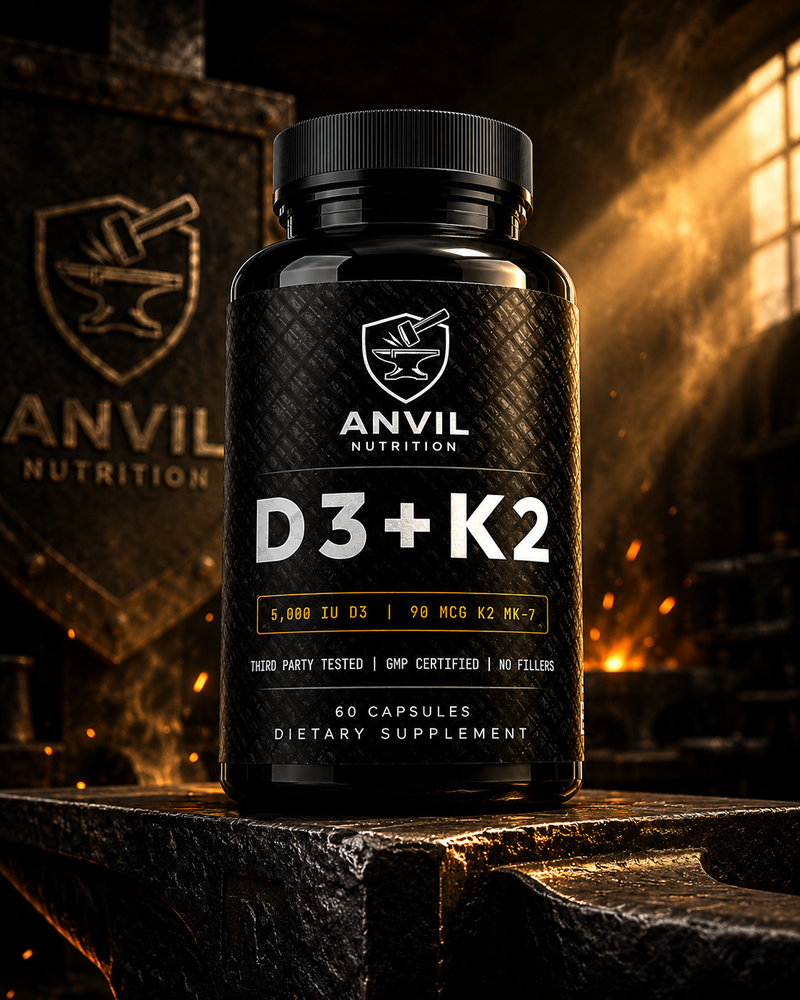
60 capsules per bottle. Two ingredients. D3 as cholecalciferol, the same form your body produces from sunlight. K2 as MK-7, the long-chain form with the longest half-life and strongest clinical evidence. No fillers, no proprietary blends, nothing else.

1 capsule daily. Each capsule delivers 5,000 IU of Vitamin D3 and 90 mcg of Vitamin K2 MK-7.
Take in the morning with a meal that contains fat. Both D3 and K2 are fat-soluble vitamins and absorb significantly better when taken with dietary fat.
D3 and K2 build up to effective tissue levels over weeks of consistent daily use. The benefits come from sustained supplementation, not single doses.
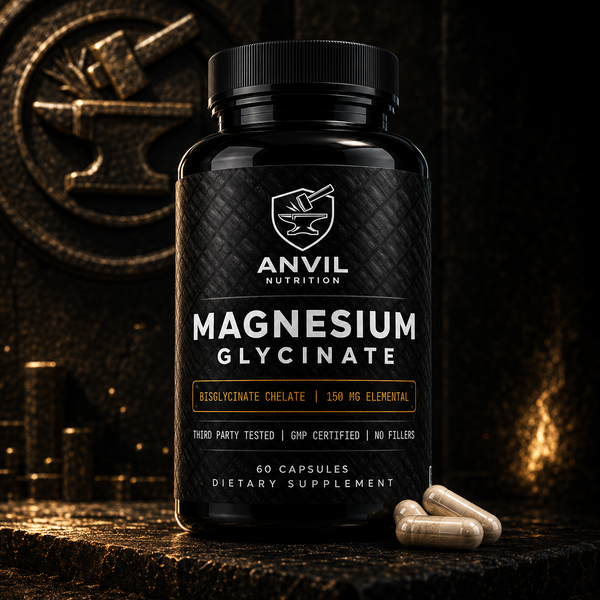
Pairs well with Anvil Zinc Bisglycinate (morning) and Magnesium Glycinate (evening). D3+K2 and Zinc are morning supplements taken with food. Magnesium is best taken before bed.

Manufactured in a GMP certified facility in the USA for Anvil Nutrition LLC. Third-party batch tested for purity and potency. Full testing results available on the Research & Testing page.