
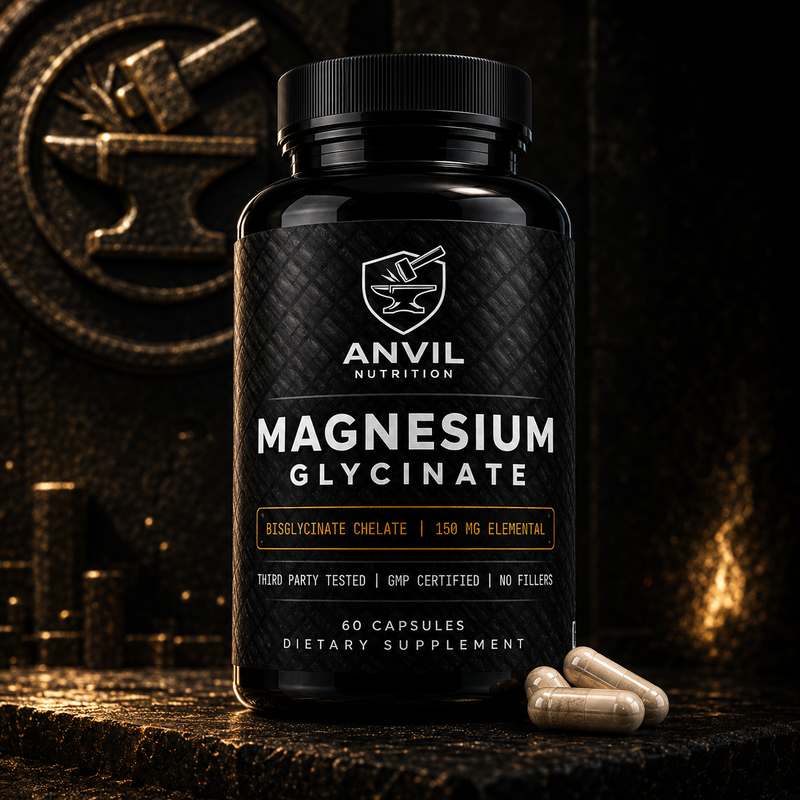
Anvil Nutrition Magnesium Glycinate
- Integrity First
- Every dose on the label
- No proprietary blends
- GMP certified
- Third-party tested
- Free shipping over $100
Details
Magnesium is involved in over 300 enzymatic reactions in your body. You need it to make ATP, and you need it every time a muscle contracts and relaxes or a nerve fires. It also goes into protein synthesis and hundreds of other processes that run every day. Almost half of Americans (48%) fell short of the required magnesium intake from food, and because serum magnesium doesn't reflect what's stored inside your cells, a normal blood test doesn't rule out a deficiency. This is 150 mg of elemental magnesium in the form that's easiest on your stomach and best suited for taking every day.

Magnesium is a cofactor in more than 300 enzyme systems that regulate everything from protein synthesis and muscle contraction to nerve function and blood glucose control. It's required for the production of ATP, the energy molecule that fuels every cell in your body. Without adequate magnesium these systems don't stop completely, but they do slow down, and you feel that as fatigue and muscle cramps first. Then recovery starts to drag and sleep breaks up, and stress gets harder to manage than it should be.
Unlike some minerals, magnesium is used and excreted every day. Your body doesn't build up a reserve the way it does with fat-soluble vitamins, so you have to bring it in every day, and that same fact is why a deficiency develops gradually and is easy to miss.
Research published in Nutrition Reviews found that 48% of Americans consumed less than the required amount of magnesium from food in 2005-2006, down from 56% in 2001-2002. Refining and processing strip magnesium out of food, with losses reported as high as 82% for white flour, 83% for polished rice, 97% for starch and 99% for white sugar. At the same time, chronic stress and strenuous exercise are both listed as causes of magnesium loss, with at least 15 mg lost in sweat per day, and probably more with heat, humidity and harder training.
The problem is that serum magnesium doesn't reflect what's stored inside your cells, where more than 99% of your total magnesium actually lives, so most deficiencies never get diagnosed because a normal blood draw doesn't rule anything out. That test gap is a big part of why a deficiency stays underdiagnosed, and the Nutrition Reviews paper ties low magnesium intake and blood levels to metabolic and cardiovascular trouble, along with elevated inflammation markers.
View Research: Suboptimal Magnesium Status in the US (Rosanoff et al. 2012, Nutr Rev) →View Research: Subclinical Magnesium Deficiency and Why a Serum Test Misses It (DiNicolantonio et al. 2018, Open Heart) →

The most common form of magnesium in cheap supplements is magnesium oxide. It has a high elemental magnesium content per capsule, which looks impressive on the label, but it's poorly soluble and well known for causing gastrointestinal distress, including cramping and diarrhea. Magnesium citrate is the other form you'll see everywhere, and at higher doses it can still cause loose stools, because it draws water into the intestines.
Those side effects matter more than they sound like they should, because they're the reason a lot of guys who try magnesium don't stick with it. If the form you're taking causes stomach issues, you either stop taking it or take less than you need, and either way the deficiency is still there.
Magnesium bisglycinate is magnesium chelated to two molecules of the amino acid glycine. In vitro and in situ studies on this exact chelate show it's absorbed in part as an intact dipeptide in the upper small intestine, and the data support the idea that it probably moves through a dipeptide transport pathway.
The linked study was a 12-patient double-blind crossover in people who had part of the small intestine removed, comparing a single 100 mg dose of magnesium bisglycinate chelate against magnesium oxide. The chelate was better tolerated by every patient. Absorption was the same for the group as a whole (23.5% versus 22.8%), and higher from the chelate only in the four patients whose absorption from oxide was most impaired (23.5% versus 11.8%), with the peak showing up about three hours earlier.
In the linked trial, the chelate was tolerated better than magnesium oxide by everyone who took both, and the paper notes most oral magnesium causes a laxative effect at therapeutic doses that makes repletion hard. Consistency is what builds and maintains tissue levels, and a form you can actually take every day without issues is a form that works.
View Research: Magnesium Bisglycinate vs Oxide, Tolerance and Absorption (Schuette et al. 1994) →
When magnesium bisglycinate is absorbed, both the magnesium and the glycine become available to your body. Glycine is an inhibitory amino acid that supports nervous system relaxation, and this is part of why the bisglycinate form is particularly well-suited for evening use.
The sleep research on magnesium is worth knowing about, as long as you read it for what it is. A 2021 systematic review and meta-analysis pooled three randomized trials, 151 older adults with trouble falling or staying asleep, and found sleep onset came 17.36 minutes sooner on magnesium than placebo (p = 0.0006). All three trials carried moderate-to-high risk of bias with low to very low quality evidence, and they used 320 mg to 729 mg of elemental magnesium a day against the 150 mg you get in one capsule here, so read it as background on what the mineral does rather than a promise about what this serving will do for you. Glycine is the calming amino acid, and it's built into the same capsule as the magnesium, which is why this is the form that makes sense to take in the evening.
View Research: Magnesium & Sleep Onset Latency Meta-Analysis (Mah & Pitre 2021) →

| Ingredient | Per Capsule |
|---|---|
| Magnesium Bisglycinate delivers 150 mg of elemental magnesium, 36% of the Daily Value | 150 mg (36% DV) |
60 capsules per bottle. One active ingredient. Other Ingredients: Vegetable Cellulose (Capsule), Organic Acacia Fiber. No fillers and no dyes. You won't find artificial sweeteners in it either, and there's no proprietary blend hiding anything.

1 capsule daily. Each capsule delivers 150 mg of elemental magnesium from bisglycinate chelate.
Take in the evening, 30-60 minutes before bed. The combination of magnesium and glycine supports relaxation and sleep quality, making this ideal for nighttime use.
Magnesium is used and excreted daily, so it's the consistent intake that builds your tissue levels over time, and the benefit comes from taking it every day rather than from any single capsule.
Pairs well with Zinc Glycinate (morning) and Methylene Blue (morning). Take magnesium in the evening and the stimulating compounds in the morning, so the timing works across your whole day.

Manufactured in a GMP certified facility in the USA for Anvil Nutrition LLC. Third-party batch tested for purity and potency. Full testing results available on the Research & Testing page.