Anvil Nutrition CoQ10
- Integrity First
- Every dose on the label
- No proprietary blends
- GMP certified
- Third-party tested
- Free shipping over $100
Details
This one is in production at our manufacturer right now, and I put the page up early so you can read the research before you spend a dollar on it. The cart button turns on the day it lands in our warehouse, and the price gets posted with it.
Every cell you own makes its energy the same way, by passing electrons down a chain of four stations inside the mitochondria, and CoQ10 is the carrier that hands those electrons across the middle of that chain. You make it yourself. Your tissues carry the most of it at around age 20 and less every year after that, and if you take a statin, the drug cuts your blood level by about 40 percent on top of the decline. This capsule is 200 mg of CoQ10 and nothing else, at the amount the research on this compound actually used.
The food you eat ends up as electrons riding on two carrier molecules, and those electrons get passed down the electron transport chain, four protein stations built into the inner wall of your mitochondria. As the electrons move from station to station, the chain pumps protons across that wall, and the pressure of those protons is what drives the enzyme that makes ATP, the energy every muscle contraction and every thought runs on. Around 90 percent of your ATP comes off this chain.
CoQ10 is the only mobile, fat-soluble carrier in it. It collects electrons from Complex I and Complex II and carries them to Complex III, which means everything upstream depends on it to move product downstream. Think of the chain as a conveyor belt in a factory, and CoQ10 as the worker standing at the junction handing packages from one station to the next. The machinery is all there and the raw materials are all there, and if that worker thins out, less moves. That is why running low on CoQ10 never feels like a stimulant wearing off. It feels like a slow drain, where recovery takes longer and training feels harder and you need more coffee to do the same day.
The same molecule does a second job when it is carrying electrons: it sits in the fat layer of your cell membranes and in your LDL particles and hands electrons to free radicals before they can damage the fat around them. So CoQ10 is both a part of the energy system and a guard on it.
View Research: Coenzyme Q Supplementation in Aging, a Review (Hernández-Camacho et al. 2018, Frontiers in Physiology) →The clearest picture of how CoQ10 changes with age comes from a Swedish study that measured it directly in human lung, heart, spleen, liver, kidney, pancreas and adrenal tissue from people aged one day to 81 years. In most of those organs the CoQ10 content was highest at about 20 years of age and then decreased continuously with every decade after. Your heart is one of the organs that runs hardest on it, and it is one of the organs where the fall shows.
That decline is the reason CoQ10 sits at the foundation of the way I think about cellular energy. Before you reach for anything more exotic to help your mitochondria, the carrier they run on should be covered, and past 40 it usually is not.
View Research: Age-Related Changes in the Lipid Composition of Human Tissues (Kalén et al. 1989, Lipids) →
Statins work by blocking HMG-CoA reductase, the rate-limiting enzyme in the pathway your body uses to make cholesterol. The problem is that CoQ10 comes off the same pathway a few steps later, so when the enzyme is blocked you make less of both. That is a fact of the chemistry, and the trials bear it out. In one of the first controlled studies, a month of pravastatin or simvastatin at 20 mg dropped plasma CoQ10 by about 40 percent in healthy volunteers, and by the same extent over three months in patients. A 2018 meta-analysis pooled 12 randomized trials with 1,776 participants and found the drop holds whether the statin is fat-soluble or water-soluble, low intensity or high, and no matter how long you have been on it.
Your doctor may never have mentioned it, because few prescribing physicians in this country bring it up. It is still happening in you every day you take the pill, and putting back what the drug removes is the reason I tell every man on a statin that CoQ10 is not optional for him.
View Research: Plasma CoQ10-Lowering Effect of Statins, Double-Blind Placebo-Controlled (Ghirlanda et al. 1993, J Clin Pharmacol) →View Research: Statin Treatment and Circulating CoQ10, Meta-Analysis of 12 RCTs (Qu et al. 2018, Eur J Med Res) →
The sore, heavy, tired muscles a lot of men get on a statin are the reason many of them quit the drug, and whether CoQ10 fixes that is a genuinely contested question, so you should see both sides. A 2018 meta-analysis of 12 randomized trials with 575 patients found CoQ10 reduced muscle pain, weakness, cramps and tiredness compared to placebo. A 2025 meta-analysis of 7 trials with 389 patients also found less pain, with four of the seven trials positive and three showing no change. On the other side, a 2020 meta-analysis of 7 trials with 321 patients found no benefit on pain and no effect on whether people stayed on their statin, and a 2015 meta-analysis of 6 trials with 302 patients found no significant benefit either. None of them found a change in creatine kinase, the blood marker of muscle damage.
Here is how I read that. The mechanism is not in dispute, the compound is one your body already makes, and the trials that found relief are as large as the ones that did not. If you are on a statin and your muscles are complaining, this is a low-risk thing to try for 60 to 90 days, and you should tell the doctor who prescribed the statin that you are taking it. Do not stop the statin on your own.
View Research: CoQ10 and Statin-Induced Myopathy, Updated Meta-Analysis of 12 RCTs (Qu et al. 2018, J Am Heart Assoc) →View Research: CoQ10 and Myopathy in Statin-Treated Patients, Meta-Analysis of 7 RCTs (Kovacic et al. 2025, J Nutr Sci) →
View Research: CoQ10 and Statin-Associated Myalgia, Meta-Analysis Finding No Benefit (Kennedy et al. 2020, Atherosclerosis) →
View Research: CoQ10 and Statin-Induced Myopathy, Meta-Analysis Finding No Benefit (Banach et al. 2015, Mayo Clin Proc) →
CoQ10 exists in two states that your cells flip between thousands of times a second. Ubiquinone is the oxidized state, the form your body makes and the form in this capsule. Ubiquinol is the reduced state. Ubiquinol is sold as a premium version, and the claim behind it is better absorption, so here is what the trials show. In a crossover in 12 healthy adults taking 200 mg a day for four weeks each, ubiquinone raised plasma CoQ10 from 0.9 to 2.5 micrograms per milliliter and ubiquinol raised it from 0.9 to 4.3. A 2026 crossover in 12 adults put a ubiquinol formulation at about twice the exposure of a ubiquinone one. So ubiquinol does absorb better, by roughly two times, and whatever form you swallow, it shows up in your blood as ubiquinol because your body converts it on the way in.
Ubiquinone is in this capsule because it is stable in a dry capsule where ubiquinol oxidizes, because it is the form the large outcome trials used, and because 200 mg of it nearly tripled plasma CoQ10 in that crossover. If you are well past 40 or on a statin and you would rather pay about double for the reduced form, that is a fair choice and I have made it myself. What you should not do is pay ubiquinol prices for a bottle that does not tell you which form is inside.
View Research: Plasma CoQ10 With Ubiquinol vs Ubiquinone, 12-Subject Crossover (Langsjoen & Langsjoen 2014, Clin Pharmacol Drug Dev) →View Research: Ubiquinol vs Ubiquinone Bioavailability, Double-Blind Crossover (Mei et al. 2026, Clin Pharmacol Drug Dev) →
The statin muscle trials in the meta-analyses above ran from 100 to 600 mg a day. The crossover that measured blood levels used 200 mg. The largest outcomes trial, covered below, used 300 mg a day as three 100 mg doses. One capsule of this puts you at 200 mg with a single swallow, which covers the general range and the low end of the statin range, and a second capsule with another meal gets you to the top of it without buying a different bottle.

A 2024 dose-response meta-analysis pooled 28 randomized trials with 830 adults and found that CoQ10 lowered the blood markers of exercise-induced muscle damage: creatine kinase, lactate dehydrogenase and myoglobin, along with malondialdehyde, a marker of oxidative stress. Every extra 100 mg a day bought a further reduction. Two things to read alongside that. Most of those trials were run in Asia, which the authors themselves flag, and the effect is on damage markers rather than on how much weight you lift. A small crossover in 15 sedentary men on 100 mg a day found mean power held up only on the last of five all-out sprints. So expect better recovery numbers before you expect a bigger number on the bar.
View Research: CoQ10 and Exercise-Induced Muscle Damage, Dose-Response Meta-Analysis of 28 RCTs (Talebi et al. 2024, Clin Nutr ESPEN) →View Research: CoQ10 and Repeated Supramaximal Exercise in Sedentary Men (Gökbel et al. 2010, J Strength Cond Res) →
The strongest outcomes data on CoQ10 comes from a two-year randomized, double-blind trial in 420 people with moderate to severe heart failure, who took 100 mg three times a day or placebo on top of their normal medication. Over those two years the CoQ10 group reached the combined endpoint of major cardiovascular events at 15 percent against 26 percent for placebo, with fewer deaths from any cause and fewer hospital stays. Read that for what it is: a trial in people whose hearts were already failing, at a dose higher than one capsule, run as an add-on to their doctors' treatment. It tells you the compound does something measurable in the organ that uses the most of it. It is not a promise about what this capsule will do for a healthy heart, and I am not going to make it one.
View Research: CoQ10 in Chronic Heart Failure, the Q-SYMBIO Randomized Trial (Mortensen et al. 2014, JACC Heart Failure) →You will see CoQ10 sold for blood pressure. When the Cochrane group applied strict criteria they found two trials with 50 people between them and no significant change in either number, so you will not find that claim on this page. If the evidence gets better, the page will change.
View Research: Blood Pressure Lowering Efficacy of CoQ10, Cochrane Review (Ho et al. 2016) →If you take a statin, this is the one supplement I would put ahead of everything else on this site, for the reason above. If you are past 40 and your energy and recovery are not what they were even though you sleep and train and eat the way you should, your carrier is one of the first places to look, because it has been falling since your twenties. And if you train hard past 40, the recovery-marker data is the case for it on training days.
CoQ10 removes a bottleneck. If the bottleneck is not there yet, because you are young and nothing is draining the carrier, there is not much for it to fix and you probably will not notice anything. The foundation comes first, meaning how you train and eat and sleep, and this capsule sits under that foundation for the man whose carrier has started to run short.
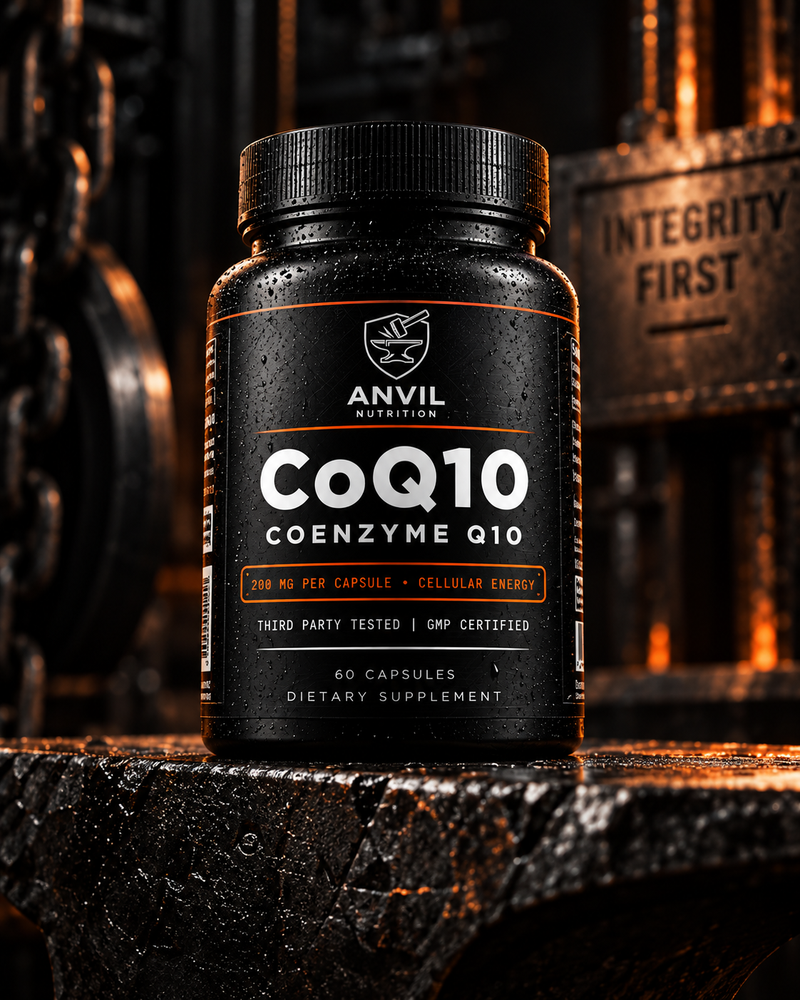
The table below is the label, line for line. Serving size is 1 capsule and there are 60 in the bottle.
| Ingredient | Per Capsule |
|---|---|
| CoQ10 Coenzyme Q10, ubiquinone. Daily Value not established | 200 mg |
60 capsules per bottle. One active ingredient. There is no proprietary blend, and nothing in the capsule that is not on the label.

1 capsule daily with water, with a meal, the way the label reads. Each capsule is 200 mg.
Take it with the meal of the day that has the most fat in it, because CoQ10 dissolves in fat and not in water. Breakfast or lunch is the safe bet. A few people report that it keeps them up when they take it late, which is their experience rather than a trial finding, so if that is you, move it earlier.
This is not something you feel in an hour the way you feel caffeine. Blood levels build over weeks of daily use, and what you tend to notice first is the absence of a drag rather than the presence of a boost. Give it 60 days before you judge it.
Take it in the same fat-containing meal as D3+K2. It pairs naturally with Methylene Blue, which routes electrons around the damaged stations of the same chain this carrier serves. The Daily Multivitamin carries no CoQ10, so there is nothing to double count. If you take warfarin, talk to your doctor before you start, because CoQ10 is structurally close to vitamin K and can work against the drug.
Weeks 1 to 4: Blood levels rising. If you are on a statin with sore muscles, this is the window where some men in the positive trials started to feel the difference, and where some did not.
Weeks 4 to 12: The honest description from men who take it is that the afternoon fade shortens and recovery between hard sessions gets a little easier, and that they notice it most in the weeks after they stop. That is their report, not a trial endpoint, and it matches how a carrier molecule would behave.
Manufactured in a GMP certified facility in the USA for Anvil Nutrition LLC. Third-party batch tested for purity and potency. Full testing results available on the Research & Testing page.