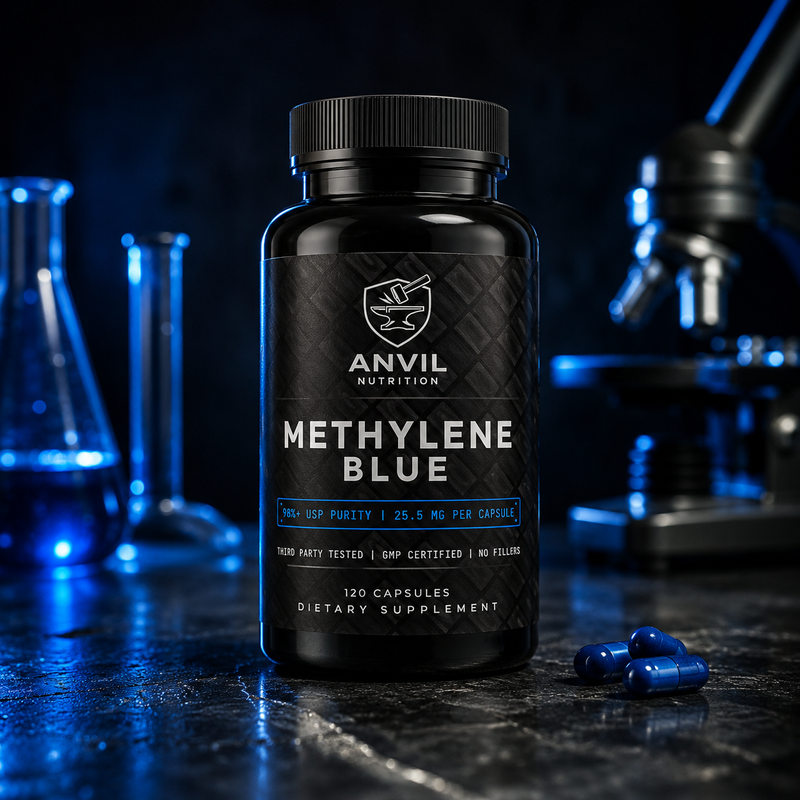
Anvil Nutrition - Methylene Blue
- Integrity First
- Every dose on the label
- No proprietary blends
- GMP certified
- Third-party tested
- Free shipping over $100
Details
Methylene blue is the first synthetic drug ever used in medicine. It was created in 1876 and being used against malaria by 1891, and today the pharmaceutical form is FDA approved as a drug for one specific blood disorder. What you're looking at here is a dietary supplement, and what's changed is that researchers are now studying methylene blue for mitochondrial support and cognitive function, so the results are worth understanding before you decide if it makes sense for you.

About 90% of your body's ATP (the energy currency that powers every cell) comes from the electron transport chain inside your mitochondria. NADH carries electrons to the chain, and those electrons pass through four stations in order, Complex I through Complex IV. As electrons move through each station, the chain pumps protons across the mitochondrial membrane. That proton gradient is what drives ATP production.
When the system works well, electrons move through all four stations and your mitochondria produce energy efficiently. The problem is that two of those stations, Complex I and Complex III, are where most of the issues develop over time. These are the most structurally complex stations with the most moving parts, which means more opportunities for things to go wrong.
As you age, electrons start to leak out at Complex I and Complex III instead of passing through to the next station. When an electron leaks out, it doesn't just disappear. It reacts with oxygen to create reactive oxygen species that cause damage inside the mitochondria. That damage makes the station leak even more electrons, which causes more damage. It's a cycle that gets worse over time, and it's one of the primary reasons energy production declines with age.
Several factors accelerate this process. Age is the biggest one because the machinery wears out. Mitochondrial membrane damage plays a role. Chronic inflammation can accelerate it, and metabolic dysfunction can overwhelm the system. Some of these factors are influenced by lifestyle, but the age-related decline in efficiency is something that happens regardless of how well you take care of yourself.
Methylene blue can accept electrons before they leak out at Complex I and Complex III, carry them past those damaged stations, and deliver them further down the chain. The electrons still reach their destination and still contribute to ATP production. They just take a different route around the stations where the leakage happens.
Think of your electron transport chain like an assembly line in a factory. Raw materials come in at one end and finished product comes out the other. Complex I and Complex III are two stations on that assembly line that have gotten worn out over time, so parts keep falling off the conveyor belt. And every part that falls off causes damage to the surrounding equipment. Methylene blue is like installing a bypass conveyor that routes around those two worn-out stations so parts can still make it to the end of the line.
The result is more electrons completing the journey, which means more ATP being produced and less oxidative damage happening inside the mitochondria.

Methylene blue has what's called a biphasic dose-response. At low doses, it supports mitochondrial function and acts as an antioxidant. At high doses, it has the opposite effect and can actually cause oxidative damage. This is one of the most important things to understand about this compound.
This is why the capsule format matters. Each capsule delivers 25.5 mg, so you know exactly how much you're taking rather than guessing with a dropper, and the label serving is 1 capsule (25.5 mg) daily.
A 2016 randomized, placebo-controlled functional MRI study enrolled 26 healthy adults between the ages of 22 and 62 and gave the methylene blue group a single low dose. The result was a statistically significant 7% increase in correct responses during memory retrieval (P=.01). Brain scans showed increased activity in the insular cortex and prefrontal regions associated with sustained attention and short-term memory. These effects showed up within one hour of a single dose.
View Research: Functional MRI Effects of Methylene Blue (Rodriguez et al. 2016, Radiology)A 2014 randomized controlled trial published in the American Journal of Psychiatry studied 42 adults with claustrophobia. Participants in the methylene blue group took a single 260 mg dose immediately after an exposure session in an enclosed chamber. Those whose fear had dropped by the end of that session showed significantly less fear at the one-month follow-up than the placebo group. Participants who were still moderately or highly fearful at the end of the session tended to do worse at follow-up on methylene blue. Contextual memory improved with methylene blue regardless of how the session went.
View Research: Fear Extinction in Adults with Claustrophobia (Telch et al. 2014, Am J Psychiatry)A 2017 study from the University of Maryland tested methylene blue on human skin fibroblasts from donors including people over 80 years old. The cells showed improved proliferation and delayed senescence, along with reduced markers of aging. A 3D reconstructed human skin model showed improved viability and wound healing, plus better hydration and a thicker dermis, and gene expression analysis of that model showed methylene blue upregulated elastin and collagen 2A1, two of the structural proteins healthy skin depends on.
View Research: Anti-Aging Potentials for Human Skin (Xiong et al. 2017, Scientific Reports)Most of the published studies on methylene blue are short-term. The Alzheimer's trials have had mixed results, and there isn't strong long-term data yet on cognitive supplementation specifically. The research is promising across multiple domains, but it's not definitive because large-scale, long-duration trials for mitochondrial support and cognitive enhancement are still in early stages.
We link every study on this page so you can read the primary sources yourself and make an informed decision rather than relying on marketing claims.
Methylene blue makes the most sense for you if you're dealing with age-related decline in energy or cognitive function. If that's fatigue that persists even when your training and nutrition are dialed in and you're sleeping well, or brain fog that doesn't resolve with lifestyle changes, or you're generally over 40 and your energy and mental clarity aren't what they used to be, methylene blue is worth investigating.
The mechanism explains why. If your electron transport chain has accumulated damage at Complex I and Complex III from years of normal use, providing a bypass route for electrons has a measurable impact on ATP output. The more damaged those stations are, the more value the bypass provides.
If you're 25, you sleep well, you train hard and eat right, and your energy is where you want it to be, you're probably not going to notice much from methylene blue. When the electron transport chain is functioning efficiently, a bypass around stations that aren't significantly damaged doesn't change the output by much. The compound addresses a specific problem, and if you don't have that problem yet, the benefit is minimal.
The foundation always comes first, meaning your training, your nutrition, your sleep and how you manage stress. Methylene blue enhances that foundation if your mitochondrial function has declined, and it doesn't replace it.
This section exists because transparency about safety is part of the standard. Every compound has a risk profile and you deserve to understand it before you make a decision. Consult with a licensed physician before using methylene blue.
G6PD is an enzyme that protects your red blood cells. Some people are born with a genetic condition where they don't produce enough of this enzyme, which means their red blood cells are more vulnerable to oxidative damage. Methylene blue needs this enzyme to function properly. In people who don't have enough of it, methylene blue can damage red blood cells and cause them to break apart.
About 4-7% of the U.S. population carries this deficiency. It's more common in people with ancestry from Africa (approximately 12% of African-American men), and in people with Mediterranean, Middle Eastern or Southeast Asian ancestry. If you have it, odds are you don't know it. A simple blood test can determine your G6PD status, and you should strongly consider getting tested before using methylene blue if you have ancestry from any of these regions.
Methylene blue affects how your body processes serotonin. Combining it with certain medications can trigger a dangerous condition called serotonin syndrome. Do not combine methylene blue with:
- SSRIs: Prozac (fluoxetine), Zoloft (sertraline), Lexapro (escitalopram)
- SNRIs: Effexor (venlafaxine), Cymbalta (duloxetine)
- MAOIs: any monoamine oxidase inhibitor
- Tramadol and Fentanyl
If you are on any of these medications, do not take methylene blue without consulting your doctor first.
- Pregnancy: Do not use methylene blue if you are pregnant. It can cause birth defects.
- Breastfeeding: Wait at least 8 days after last use before breastfeeding.
- Kidney problems: Use with caution and consult your physician.
Your urine will turn blue or green. Your tongue and mouth may turn blue temporarily. These are expected and harmless. Methylene blue can also interfere with sleep if taken too late in the day due to its effects on mitochondrial energy production. Take it in the morning or early afternoon.

Methylene blue is also used in fish tanks and for laboratory staining, along with other industrial applications. Products made for those uses can contain heavy metals like arsenic and lead at levels that are not safe for human consumption. Just because something is labeled "methylene blue" does not mean it's safe to ingest.
This product is made from 98% USP grade methylene blue, meaning the raw material meets the United States Pharmacopeia monograph purity specification for methylene blue. It is manufactured in a GMP certified facility in the USA and third-party batch tested for both purity and heavy metal contamination. If the methylene blue you're looking at isn't USP grade and isn't made in a GMP facility, you should not be putting it in your body.

| Ingredient | Per Serving (1 Capsule) |
|---|---|
| Methylene Blue (98% USP) USP grade raw material | 25.5 mg |
120 capsules per bottle. The label serving is 1 capsule (25.5 mg) daily, so one bottle is 120 servings.
1 capsule (25.5 mg) daily, which is the label serving. Consult your physician before you start, especially if you take any medication.
Take in the morning or early afternoon. Methylene blue supports mitochondrial energy production and can interfere with sleep if taken too late in the day.
Methylene blue addresses the electron transport chain bypass. It can complement other mitochondrial support compounds like NAD+ precursors (fuel), creatine (ATP storage), and membrane-supporting compounds through different mechanisms.

98% USP grade methylene blue. Manufactured in a GMP certified facility in the USA for Anvil Nutrition LLC. Every batch is third-party tested for purity and potency and screened for heavy metal contamination. Full testing results available on the Research & Testing page.