Quench Hydration + Performance, Citrus Lime
- Integrity First
- Every dose on the label
- No proprietary blends
- GMP certified
- Third-party tested
- Free shipping over $100
Details
This one is in production at our manufacturer right now, and I put the page up early so you can read the research before you spend a dollar on it. The cart button turns on the day it lands in our warehouse, and the price gets posted with it.
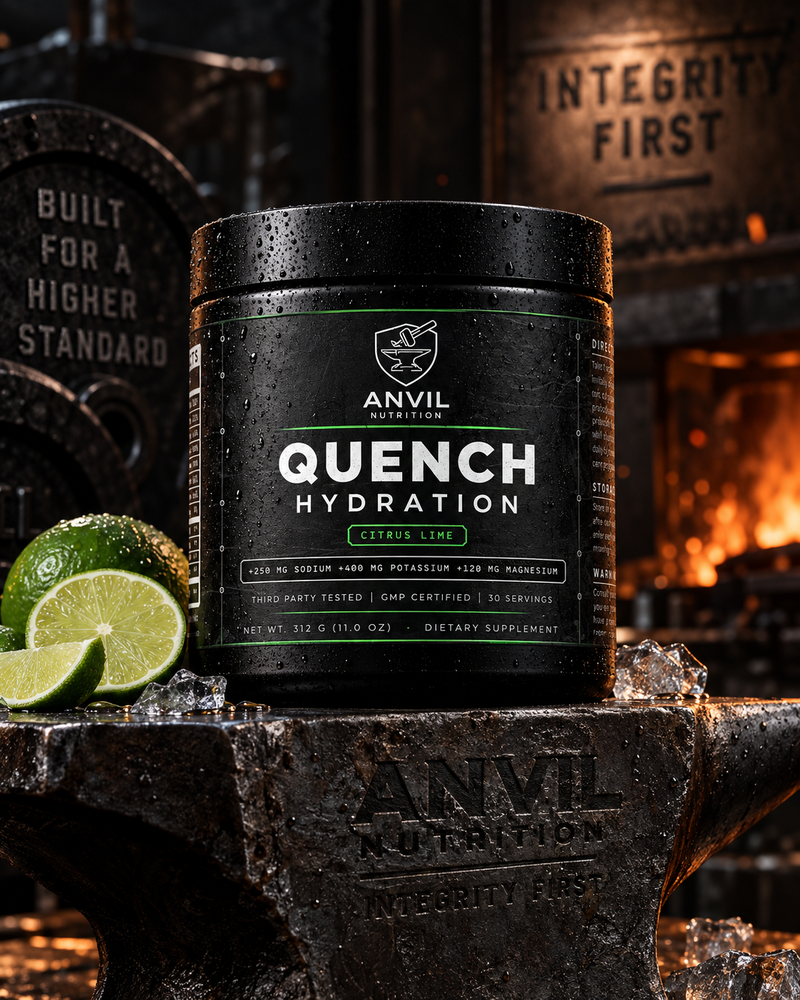
If you think hydration means drinking more water, you have half of it. Water follows sodium, and it follows the glucose and amino acids your gut pulls in alongside it, so what is dissolved in the bottle decides how much of that water you keep. The hydration powders you see everywhere solve that with a thousand milligrams of sodium, which is the one mineral you already get too much of. Quench runs the other way. It puts the potassium and magnesium you are short on in front, keeps sodium at 250 mg because that is enough to switch the water pump on, and moves water through three separate doors in your gut instead of one. One scoop if you take IGNITE or the Anvil minerals already, two if you do not, and every dose is on the label.
Pull the national intake data and the picture is lopsided. In an analysis of 16,110 Americans from the NHANES survey, only 3 percent reached the adequate intake for potassium even after supplements were counted, and 45 percent came in under the requirement for magnesium. The same survey series run through 2018 on 39,925 adults found those two minerals still underconsumed and sodium overconsumed. The CDC's own read of that data is that adults in this country eat past the 2,300 mg sodium guideline and land under the 3,400 mg of potassium a man is supposed to get every day.
So when a hydration powder hands you another 1,000 mg of sodium, it tops up the one thing you already have plenty of and does nothing for the two you are short on. That is the gap Quench is built to fill, and it is why potassium is the biggest mineral on this label at 400 mg, with magnesium at 120 mg.
View Research: Where Americans Get Their Nutrients, NHANES 2003-2006 (Fulgoni et al. 2011, J Nutr) →View Research: Micronutrient Intake Trends in US Adults, NHANES 2003-2018 (Freedman et al. 2024, Am J Clin Nutr) →
View Research: Top Food Sources of Sodium and Potassium in the US (Woodruff et al. 2020, CDC MMWR) →
Sodium is not the villain here, and a formula with none of it would absorb worse. The pump that pulls water across your gut wall runs on sodium and glucose together, so the 250 mg in a scoop is there to run that pump, and the amount was chosen so a day of Quench, IGNITE and food does not push you past the range the outcome data favors. In the PURE study of 101,945 people across 17 countries, the lowest risk of death or a major heart event sat between 3 and 6 grams of sodium a day, and the people above 7 grams did worse along with the people below 3 grams. Higher potassium intake was tied to lower risk. That is the balance this label is built around.
View Research: Urinary Sodium and Potassium, Mortality and Cardiovascular Events, PURE (O'Donnell et al. 2014, NEJM) →
Your small intestine takes in around 10 liters of water a day, and it does most of that without any pressure pushing the water through. The water rides on the transporter that moves glucose and sodium into your gut wall. When that transporter was studied on its own, every glucose molecule it carried dragged 260 water molecules with it, which the authors estimated accounts for about 5 liters of your daily water absorption by itself. That is the mechanism oral rehydration solution has used for decades, and it is the reason there are 3.5 g of dextrose in a scoop. The sugar is there to carry water, and 3.5 g is a small amount for that job.
You can see the effect in a bottle test. Maughan's group gave 72 men a liter each of 13 different drinks and measured what came back out over four hours. Plain water produced 1,337 g of urine. An oral rehydration solution built on this pump produced 1,038 g, and at the two hour mark it had held about 54 percent more of its fluid than water had. Cola, a sports drink, coffee, tea and orange juice all behaved like water.
View Research: Cotransport of Water by the Sodium/Glucose Cotransporter (Loo et al. 1996, PNAS) →View Research: The Beverage Hydration Index, 72 Men and 13 Drinks (Maughan et al. 2016, Am J Clin Nutr) →
Glutamine does not use the glucose pump. It has its own sodium-linked transporter in the gut wall, and in a jejunal perfusion study of 19 adults with acute cholera, glutamine given with glucose stimulated water absorption to the same degree glucose managed on its own. Glutamine is also the fuel your gut lining burns first, which is a sensible thing to feed a gut you are asking to absorb a lot of water.
View Research: L-Glutamine and Jejunal Salt and Water Absorption in Humans (van Loon et al. 1996, Eur J Gastroenterol Hepatol) →View Research: Amino Acid Transport Across Intestinal Epithelia (Bröer 2008, Physiological Reviews) →
Glycine is carried by a separate transporter again, so on mechanism you have three independent routes into the gut wall. Read the human data for what it is, though. When researchers fortified standard oral rehydration solution with glycine for children with diarrhea, it rehydrated them fine and it did not beat the standard solution, and in animal perfusion work adding glycine lowered net absorption because it pushed the osmolality up. We took the lesson from that in the dose. Glycine sits in Quench at 1 g, low enough to keep the drink hypotonic, and the amino acids as a group are capped for the reason below.
View Research: Glucose/Glycine vs Standard Oral Rehydration Solution (Pizarro et al. 1988, J Pediatr Gastroenterol Nutr) →View Research: Optimising Oral Rehydration Solution Composition in Small Intestine Models (Sandhu et al. 1989) →
More amino acid is worse past a point. In three crossover trials at Loughborough, groups of 15 to 17 people drank beverages carrying different amino acid loads with heavy water added as a tracer, and the researchers tracked how fast that tracer showed up in their blood. A small amount, 3.5 g per liter, got fluid into circulation faster than a carbohydrate sports drink did. Five times that amount slowed delivery down. Quench carries 2.5 g of amino acids in a 16 oz scoop, which keeps it well under the load that slowed delivery. That ceiling is why there are no EAAs in this formula, and it is why you should not dump a scoop of protein powder into the same shaker.
View Research: Amino Acid Concentration and Water Uptake Kinetics, Three Crossover Trials (Funnell et al. 2024, Eur J Nutr) →Osmolality is how crowded a drink is with dissolved particles. A drink more concentrated than your blood pulls water into your gut before it gives any back, and a drink less concentrated than your blood moves the other way. A meta-analysis of 28 studies and 68 drink treatments during continuous exercise found that hypotonic drinks, meaning under 275 mOsmol/kg, were the most likely to hold plasma volume, ahead of isotonic drinks with a probability the authors put at 98 percent, and ahead of hypertonic drinks and plain water. Quench was built to that line. The finished formula was measured by an outside lab at 261 mOsmol/kg, and the sweetener system was chosen so nothing pushed it over: no sugar alcohols, and a stevia extract dosed in milligrams.
View Research: Hypertonic, Isotonic and Hypotonic Drinks and Hydration During Exercise, 28-Study Meta-Analysis (Rowlands et al. 2022, Sports Medicine) →The NIH depletion and repletion study that set the modern vitamin C recommendation found that a single 200 mg dose is absorbed completely, that your immune cells are saturated by 100 mg a day, and that at 500 mg and above the extra mostly ends up in your urine. So 200 mg is the dose your body actually takes up, and a full gram would be a bigger number on the label with nothing behind it.
View Research: Vitamin C Pharmacokinetics in Healthy Volunteers (Levine et al. 1996, PNAS) →You do lose zinc in sweat, and the amount is small. In cyclists riding for two hours, sweat zinc came to about 9 percent of the daily allowance for men and 8 percent for women. Zinc is here because 8 percent of Americans in the intake data still come in under the requirement, and because the bisglycinate form is absorbed through amino acid transport and is easy on an empty stomach. It is the same form in the Anvil Zinc Glycinate capsule.
View Research: Sweat Iron and Zinc Losses During Prolonged Exercise (DeRuisseau et al. 2002) →View Research: Zinc Loss in Sweat of Athletes in Hot and Neutral Temperatures (Tipton et al. 1993) →
B6 and B12 are here in small amounts near the daily value, and the B12 is methylcobalamin, the same form the Daily Multivitamin uses. Both are water-soluble, so a scoop on top of the multi does not push you toward any upper limit.
Vitamins D, E and K and the trace minerals stay out of Quench because you already get them from the multi and from D3+K2, and a water mix is the wrong vehicle for a fat-soluble vitamin anyway. Everything in this canister dissolves in water, which is what makes the one scoop rule safe to stack with the rest of the lineup.
Every ingredient in this formula had to pass two tests: you are measurably short on it, or it moves water. Here is what failed and why.
| Ingredient | Why It Is Not In Quench |
|---|---|
| Creatine | It is already in the Creatine tub and in your stack. Putting it here would double dose you. |
| EAAs and protein | Past a small amount, amino acids slow fluid delivery instead of speeding it, in the Funnell trials linked above. |
| Collagen | We could not find a study showing it improves hydration. |
| Coconut water powder | Its potassium is real, and its minerals move from batch to batch. The citrate salts hit the same number every time. |
| Selenium, chromium, boron | Already in the Daily Multivitamin, and nothing ties them to hydration. |
| Erythritol and other sugar alcohols | They add osmolality and push a hypotonic drink toward isotonic. |
| Sucralose | Reb M stevia gets to the same sweetness without it. |
| 1,000 mg of sodium | You already get more than the guideline, and the PURE data linked above favors a daily range, not a bomb per serving. |
The table below is the label, line for line. Serving size is 12.2 g, about one scoop. The canister holds 60 servings, and two scoops doubles every line.
| Ingredient | Per Scoop |
|---|---|
| Vitamin C as Ascorbic Acid, 222% Daily Value | 200 mg |
| Vitamin B6 as Pyridoxine HCl, 118% Daily Value | 2 mg |
| Vitamin B12 as Methylcobalamin, 250% Daily Value | 6 mcg |
| Electrolytes | |
| Potassium as Potassium Citrate, 9% Daily Value | 400 mg |
| Sodium as Sodium Citrate, 11% Daily Value | 250 mg |
| Magnesium as Magnesium Citrate, 29% Daily Value | 120 mg |
| Zinc as Zinc Bisglycinate Chelate, 91% Daily Value | 10 mg |
| Absorption | |
| Dextrose runs the sodium and glucose water pump | 3,500 mg |
| L-Glutamine free form | 1,500 mg |
| L-Glycine free form | 1,000 mg |
Sweetened with a rebaudioside M stevia extract and nothing else. There are no sugar alcohols in it and no sucralose. No dyes either, and no proprietary blend hiding an amount.

1 scoop (12.2 g) in 16 oz of cold water, once a day, with or around a meal, the way the label reads.
If you do not take IGNITE, the multi or the Anvil minerals, take 2 scoops in 20 to 24 oz. That doubles every line on the panel and keeps the drink at the same concentration, because you doubled the water with it.
First thing in the morning, after seven or eight hours without a drink, or in the shaker during a session. There is no caffeine in it, so the clock does not matter.
Quench was flavored to be mixed with IGNITE, so on training days one scoop of each goes in the same shaker and your sodium for the session lands at 750 mg. Creatine mixes in fine. If you take the Daily Multivitamin, that is the one scoop case, because the multi already carries zinc, B6 and B12.
There is no caffeine and no salt hit, so you will not feel it the way you feel IGNITE. What changes is what you hold on to. In the Maughan trial an oral rehydration drink built on the same pump kept about half again as much of its water as plain water did over the first two hours, so the first thing you tend to notice is a big glass of water staying with you instead of running straight through. Give the minerals a couple of weeks of daily use before you judge them, because potassium and magnesium status builds over time, the same as the magnesium capsule.
Manufactured in a GMP certified facility in the USA for Anvil Nutrition LLC. Third-party batch tested for purity and potency. Full testing results, including the osmolality report on the finished formula, are on the Research & Testing page.
Complete Your Stack
Anvil Nutrition "Integrity First" Tee
Anvil Nutrition - Creatine Monohydrate
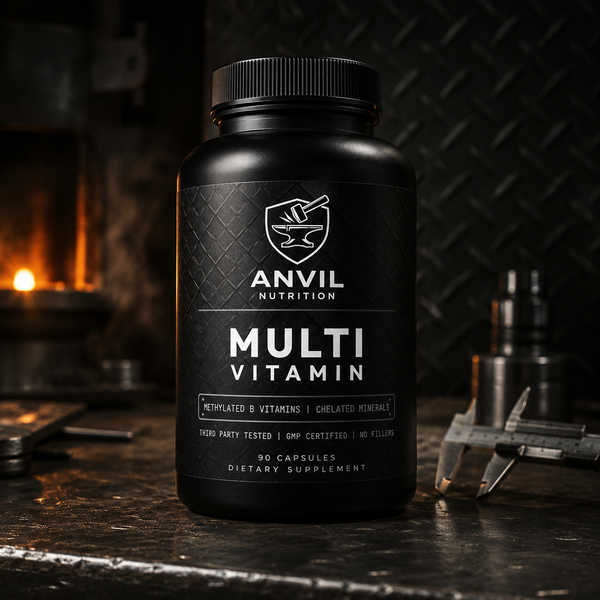
Anvil Nutrition - Daily Multivitamin
 Sold Out
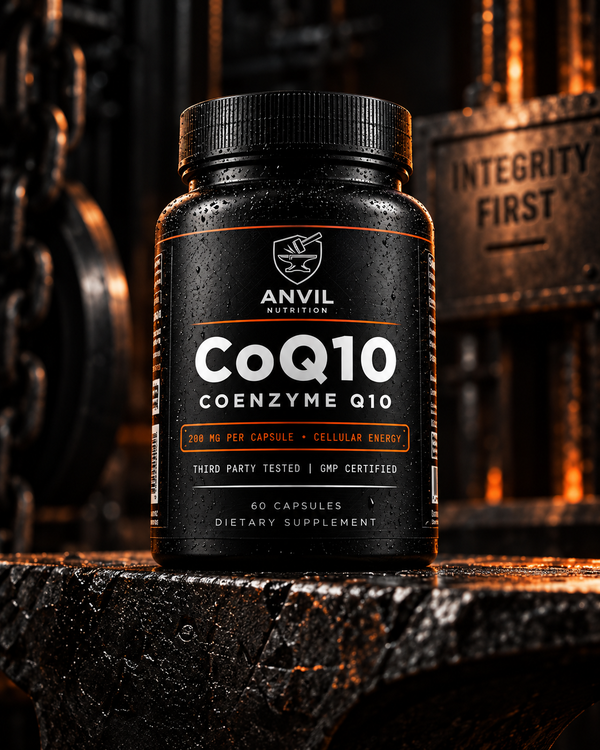
Anvil Nutrition CoQ10
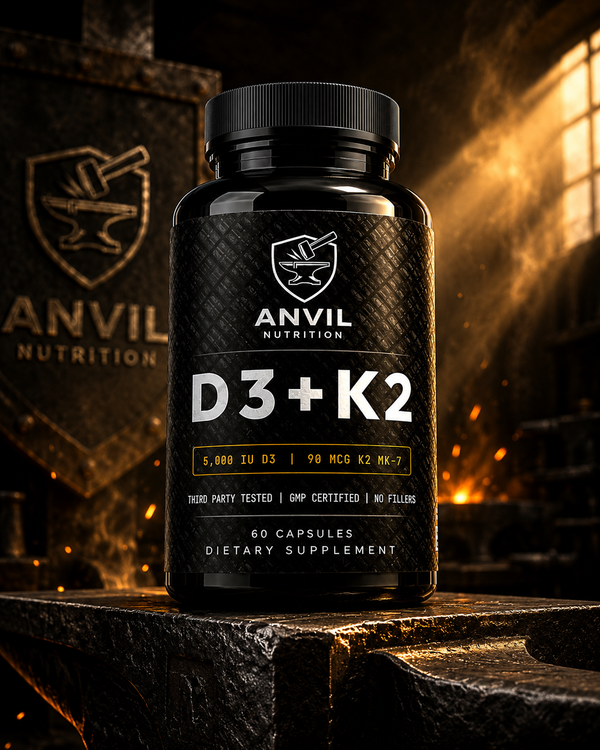
Anvil Nutrition D3+K2
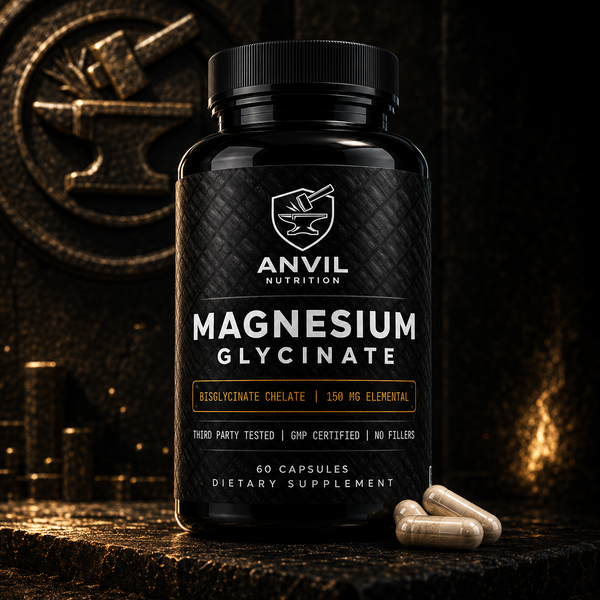
Anvil Nutrition Magnesium Glycinate
 Sold Out
Anvil Nutrition NAC
 Sold Out